A compact travel umbrella is a category most people get wrong. They buy the smallest one in the store, discover it's also the cheapest, and watch it invert in the first real wind on a Mumbai monsoon evening. The right compact umbrella is small enough to forget you're carrying it — and good enough to remember when it matters.
This is a guide to picking one if you fly often, commute by metro or auto, or just need an umbrella that doesn't take up half your bag.
- Compact umbrellas live or die on three numbers: folded length, open canopy, weight.
- Three-fold construction packs smaller; two-fold is lighter and more reliable.
- Under 35 cm folded length fits a carry-on side pocket.
- A good compact umbrella costs more than a station-platform one. It also lasts ten times longer.
Three numbers that matter.
1. Folded length
The single most important spec for a travel umbrella. The benchmarks:
- Under 25 cm — ultra-compact. Fits a small tote, a laptop bag side pocket, a women's purse.
- 25–35 cm — standard compact. Fits a backpack side pocket and most carry-on side pockets.
- Over 35 cm — not really compact. Will hang outside or sit inside the main compartment.
2. Open canopy diameter
Compact umbrellas trade canopy size for pack size. The benchmarks:
- Under 90 cm canopy — single-person coverage only, one shoulder will be wet in heavy rain.
- 90–100 cm canopy — comfortable single-person coverage, sufficient for the airport-to-cab walk.
- Over 100 cm canopy — covers you and a bag, the practical limit for "compact" anything.
3. Weight
A compact you don't carry is a compact that fails. Aim for 250–350 grams. Lighter than 200 grams is usually a frame compromise; heavier than 400 grams is a folding umbrella, not a compact.
Two-fold vs three-fold.
Two-fold
Folds in half once. Larger packed size, but a simpler frame with fewer moving parts. Generally more reliable — fewer joints means fewer failure points. The trade-off is bulk.
Three-fold
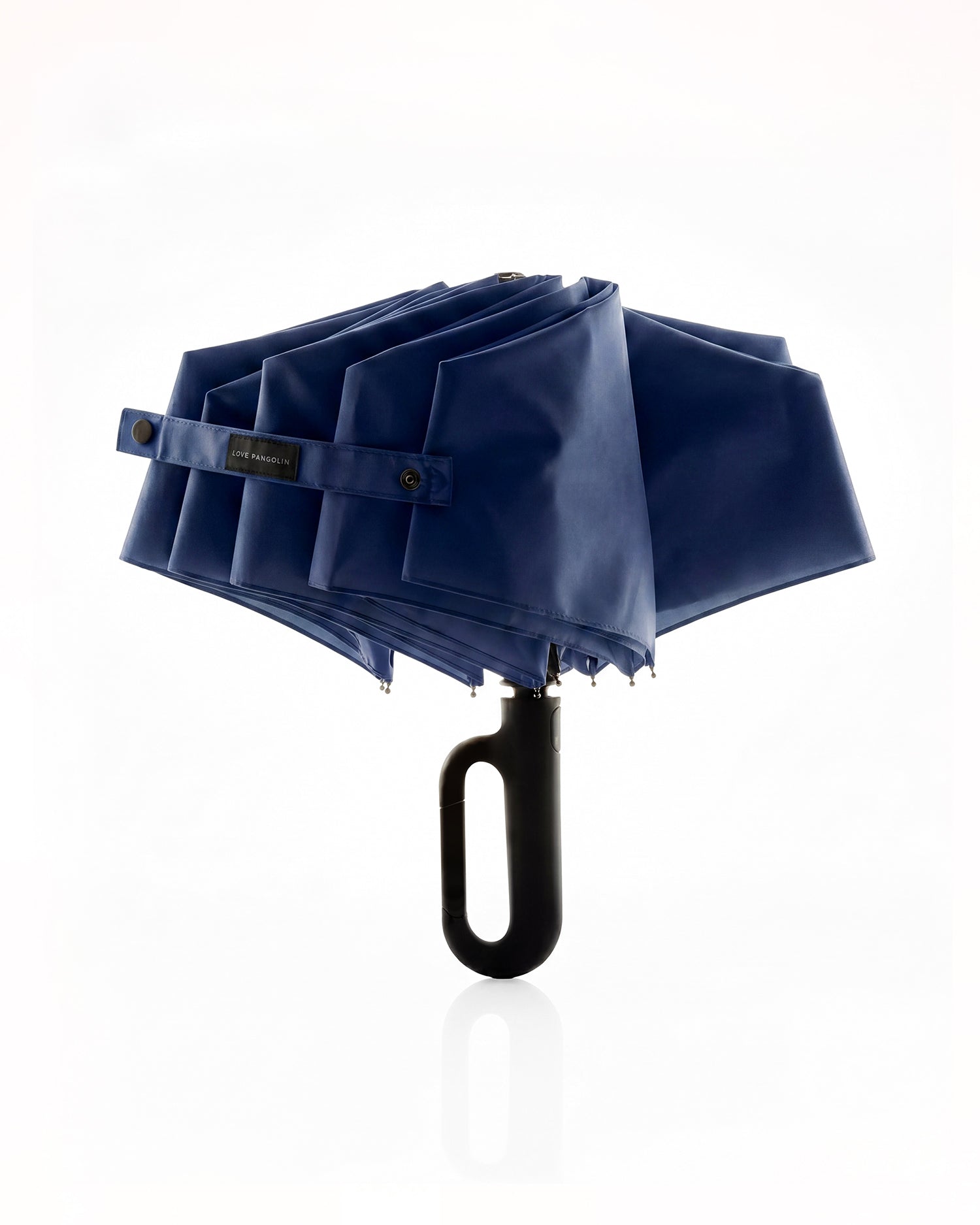
Folds in three. Much smaller packed size — this is what makes "carry-on" carry-on. More joints, more articulation in the frame. Slightly less robust in heavy wind, but enough for most monsoon use.
For travel specifically, three-fold wins on pack size. For daily monsoon use over years, two-fold tends to last longer.
Flights — what fits in a carry-on.
Most airlines allow umbrellas in carry-on luggage. The practical constraint isn't airline policy — it's where to put it. The good places:
- Front exterior pocket of a hardshell carry-on — best for ultra-compacts under 25 cm
- Side mesh pocket of a backpack — works for any compact under 35 cm
- Laptop sleeve pocket — works for the smallest folded umbrellas
- Inside main compartment, lying flat against the divider — fine for anything that fits
"A compact umbrella you don't carry is a compact umbrella that fails. The smallest weights and shortest folded lengths matter more than canopy size."— From the Love Pangolin Lab
What to skip.
- Pencil-thin canopy frames — they look elegant in the photo and bend in real wind.
- Battery-powered fans built into umbrella canopies. The novelty wears off, the battery doesn't.
- Capsule umbrellas without a vent. Modern compact umbrellas can be vented; if it isn't, you're paying for size and giving up wind resistance.
- Auto-open ultra-compacts. The mechanism is the most failure-prone part of a compact umbrella. Manual is more reliable.
What we make.
The Rainster Compact 2.0 is Love Pangolin's travel umbrella — 3-fold construction with a clip handle, DuraDry canopy, fibreglass-composite frame. Engineered to fit a backpack side pocket and survive a real monsoon, not just a light drizzle.
Shop the collection: Rainster Unisex Umbrellas →
Quick recap.
- Three numbers: folded length (under 35 cm), canopy (90–100 cm), weight (250–350 g).
- Three-fold packs smaller; two-fold lasts longer.
- Manual mechanism is more reliable than auto-open.
- Skip ultra-light pencil frames — they bend in real wind.